
Why it happens
Acne is one of the best-understood skin conditions in medicine, and one of the most misunderstood in everyday life. Here's what's actually going on: what acne is, what causes it, and why some people get it worse than others.
It starts in a tiny structure called a pilosebaceous unit
Acne is a condition of the pilosebaceous unit — a small structure in your skin made up of a hair follicle (a "pore") and an attached oil gland called a sebaceous gland. The oil these glands produce is called sebum.
In a normal pore, sebum travels up to the surface of your skin, dead skin cells shed and flake off, and everything moves along quietly. Acne begins when this smooth process breaks down and the pore gets plugged.
That's also why acne shows up in specific places: the face, chest, back, and shoulders — the parts of the body where sebaceous glands are largest and most numerous. It rarely appears on your palms or shins for the same reason.
Four things go wrong at once
Dermatologists describe four biological processes that together produce acne. They interact with each other rather than happening in a strict sequence — often all four are underway at the same time in the same pore.
Excess oil (sebum)
Under the influence of hormones called androgens, oil glands enlarge and produce more sebum than the skin can easily clear.
Sticky dead skin cells
Cells lining the pore normally flake off and get carried away. In acne, they become sticky, clump together, and mix with oil to form a plug.
A skin bacterium called C. acnes
Cutibacterium acnes lives harmlessly in almost everyone's pores. It thrives in the oil-rich, oxygen-poor environment of a clogged pore and releases substances that trigger inflammation.
Inflammation
Your immune system reacts to the bacteria and to the ruptured pore. That reaction is what creates the redness, swelling, warmth, and pain of a pimple.
How a lesion actually develops
The earliest stage is a microcomedone — an invisible plug forming deep in the pore. From there:
A comedone becomes either a blackhead (the plug reaches the surface and darkens from oxidation — not dirt) or a whitehead (it stays trapped under the skin). If inflammation kicks in, it becomes a papule (a small red bump), a pustule (with visible pus), or, deeper down, a painful nodule or cyst.
Hormones and genes do most of the heavy lifting
If you rank all the things that influence whether someone gets acne, hormones and genetics dominate the list. Most of the other factors people worry about — diet, stress, skincare — sit far below these two.
Hormones
Androgens are a group of hormones — including testosterone, DHT, and DHEA-S — that bind to receptors in your oil glands and tell them to grow and produce more sebum. Interestingly, most people with acne have completely normal hormone levels in their blood. The action happens locally, right in the skin.
This is why the timing of acne is so predictable. Oil production starts to rise around age 7 or 8 (during a stage called adrenarche, when the adrenal glands begin producing androgens) and accelerates through puberty, peaking in the late teens and early twenties. One of the most compelling pieces of evidence for how central androgens are: people who genetically lack functional androgen receptors don't develop acne at all.
For women, acne often tracks with the menstrual cycle. Studies show most women with acne notice a flare in the week or so before their period, when estrogen drops and the hormonal balance shifts. Many women also develop what's often called "hormonal acne" along the jawline and lower face (the "U-zone") — often deeper, more inflammatory, and more resistant to over-the-counter products.
Conditions of androgen excess — like polycystic ovary syndrome (PCOS) — frequently cause or worsen acne. Persistent adult acne, especially alongside irregular periods or excess hair growth, is worth mentioning to a doctor because a hormonal evaluation can help clarify what's going on.
Genes
The other huge driver — and the one people tend to underestimate — is genetics. A large twin study found that about 81% of the variation in who gets acne is explained by genes. A second, independent study estimated 85%. Having a parent or sibling with acne substantially raises your risk, and family history predicts more severe and more persistent breakouts.
There's no single "acne gene." Many genes contribute — some affecting oil production, some affecting how your follicles behave, some affecting how strongly your immune system responds to inflammation. The practical takeaway: two people with the exact same diet and skincare routine can have wildly different skin, largely because of biology they were born with.
Not all bacteria on your skin are bad
The old idea that acne is an "infection" caused by bad bacteria is outdated. Cutibacterium acnes — the bacterium linked to acne — is actually a normal resident of healthy skin. It helps maintain the skin's protective acidity and crowds out more harmful bacteria. Some strains of C. acnes are even associated with clear skin.
What matters is the balance and type of bacteria, not the mere presence of the bug. Inflamed acne is linked with a less diverse, less healthy microbial community on the skin — an imbalance dermatologists call dysbiosis.
This is part of why oral antibiotics for acne are a mixed bag: they can calm inflammation, but overusing them can disrupt beneficial bacteria and drive antibiotic resistance. It's also why treatments like benzoyl peroxide are so useful — they reduce C. acnes without teaching the bacteria to resist antibiotics.
Diet, stress, and lifestyle — what the evidence actually shows
Beyond hormones and genes, a handful of everyday factors can nudge acne in one direction or the other. None of them cause acne on their own — but they can matter. Here's the current evidence, from strongest to weakest.
Lifestyle factors that can matter
- StressRaises cortisol, which can worsen acne. A Stanford study of college students during exams found acne severity increased with stress levels.
- Sleep lossAlso raises cortisol and impairs the skin's overnight repair cycle.
- Occlusion (acne mechanica)Friction and pressure from masks, phones against the cheek, helmets, and headbands can trigger a specific form of acne.
- Cosmetics and hair productsSome products clog pores. Look for "non-comedogenic" and "oil-free" labels.
- PollutionFine particulates and ozone generate oxidative stress in the skin and are associated with acne in some populations.
- Heat & humidityIncrease sweat and oil, which can worsen breakouts — particularly in warmer climates.
The marks and scars — and why they matter
Because acne is an inflammatory condition, it can leave lasting changes on the skin even after the active pimple is gone. Understanding the difference between them matters, because they respond to different treatments.
Marks (not true scars) — flat discolorations that usually fade with time
Flat brown, gray, or dark marks
Caused by inflammation triggering pigment-producing cells to overproduce melanin. Much more common and more persistent in people with medium to deep skin tones. Sun exposure makes it worse.
Flat pink, red, or purple marks
Caused by small blood vessels dilating or being damaged during healing. More visible on lighter skin tones. Usually fades faster than PIH but can last months.
True scars — permanent changes in skin texture
Atrophic scars (depressed or pitted)
Caused by loss of collagen when deep inflammation damages the tissue underneath. Three common types: ice pick (narrow and deep), boxcar (broad with sharp edges), and rolling (wavy).
Hypertrophic and keloid scars (raised)
Caused by overproduction of collagen during healing. Hypertrophic scars stay within the original lesion's borders; keloids grow beyond them. More common on the chest, shoulders, upper back, and jawline — and in deeper skin tones.
A 2023 review of 37 studies found scars in about 47% of people with acne. The deeper and longer-lasting the inflammation, the higher the risk of scarring — which is why dermatologists urge treating acne earlier rather than "waiting it out."
Why acne peaks in the college years
Acne is most common precisely when androgen-driven oil production is at its peak — the late teens and early twenties. It affects up to 50 million Americans each year, and roughly 85% of people between ages 12 and 24 experience at least mild acne.
Two things worth knowing about that peak:
First, adolescent acne often persists well into the 20s and 30s. Roughly 50% of women experience acne in their 20s, and 30–40% in their 30s.
Second, adult-onset acne — acne that appears for the first time after age 25 — is increasingly recognized, especially in women.
If you're a college student dealing with breakouts, you're squarely in the largest and best-studied group affected by this condition. That doesn't make it less annoying — but it does mean you're not an outlier, and effective, evidence-based treatments have been developed for exactly this stage of life.
Lesion Types
Acne shows up differently depending on depth and inflammation — and it can look different across skin tones. Tap a lesion type to see how it presents.
Comedones (whiteheads & blackheads)
Clogged pores that either stay closed at the surface (whiteheads) or open to the air and oxidize (blackheads). The dark color of a blackhead comes from oxidized melanin and sebum — not dirt. Comedones are the precursor to inflammatory lesions and respond well to retinoids and salicylic acid.
Required
Wong et al. 2024 · Fig 3

© Roshu Bangal
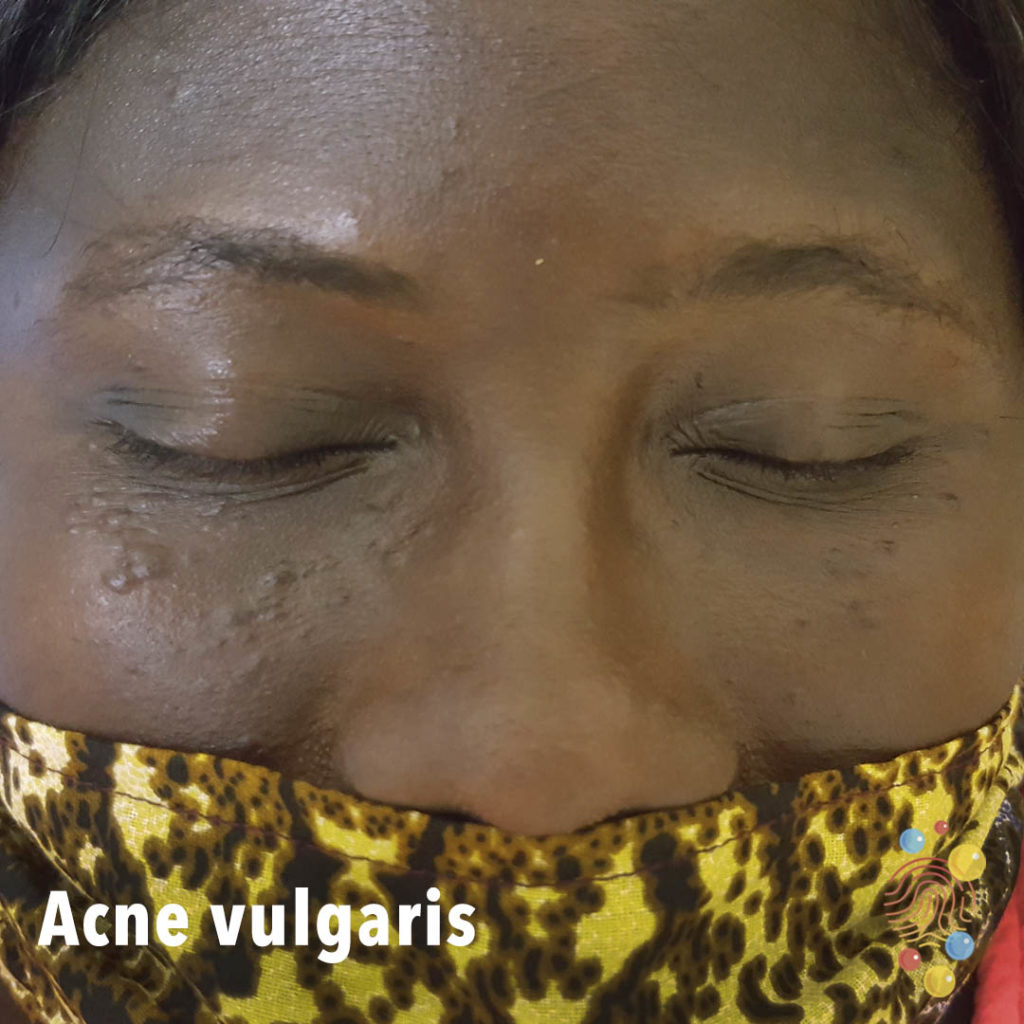
Inclusive skin atlas
Papules
Small, raised, inflamed bumps without visible pus. Often tender to the touch. On lighter skin tones, papules typically appear red or pink. On deeper skin tones, they can present as darker, purple-brown, or violet-toned bumps — which doesn't change the underlying diagnosis.

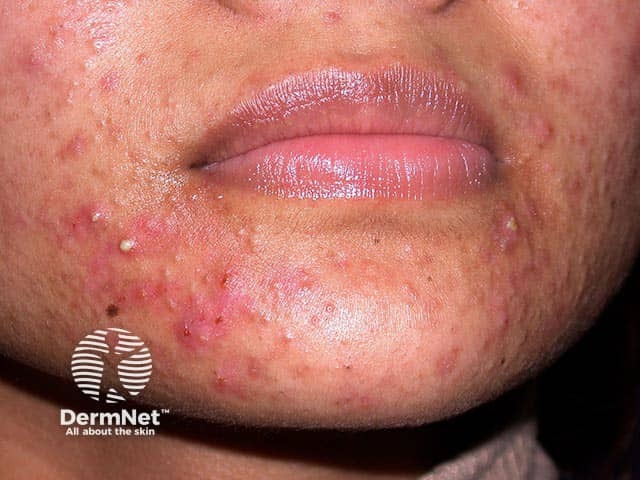
Mixed facial acne, skin of colour
SOC Review
Retinoids in SOC · Fig 1
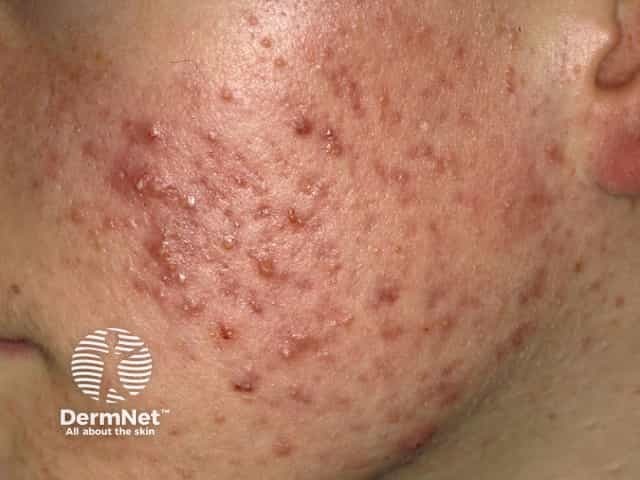
Pustules
Inflamed bumps with visible white or yellow pus at the tip — the classic "pimple." Result from C. acnes proliferation triggering an immune response in the follicle wall. Pustules can appear anywhere on the face, chest, back, or shoulders and generally respond well to topical treatments.

Atlas Site
"Acne" gallery
Permission
Pustular acne in SOC
Nodules & Cysts
Deeper, larger lesions that develop when inflammation extends beyond the follicle. Nodules are firm, painful lumps under the skin; cysts are similar but pus-filled and even more inflammatory. Both are the most likely to cause scarring and typically require prescription-strength treatment.
Severe acne image
Category
high-resolution
IRB-consented
Case 4 · 16yo Black male
Myths vs. Facts
A lot of what circulates about acne, on social media and off, is either overstated or outright wrong. These five myths are worth addressing directly because they can actually get in the way of finding something that helps.
Common Treatments
A guide to the treatment landscape — over-the-counter options, prescriptions, and what to actually expect. Coming soon.
This section is being written
The Common Treatments tab is intentionally empty for now. Content will cover OTC ingredients, prescription topicals and oral medications, isotretinoin, and the principles that make routines actually work.